
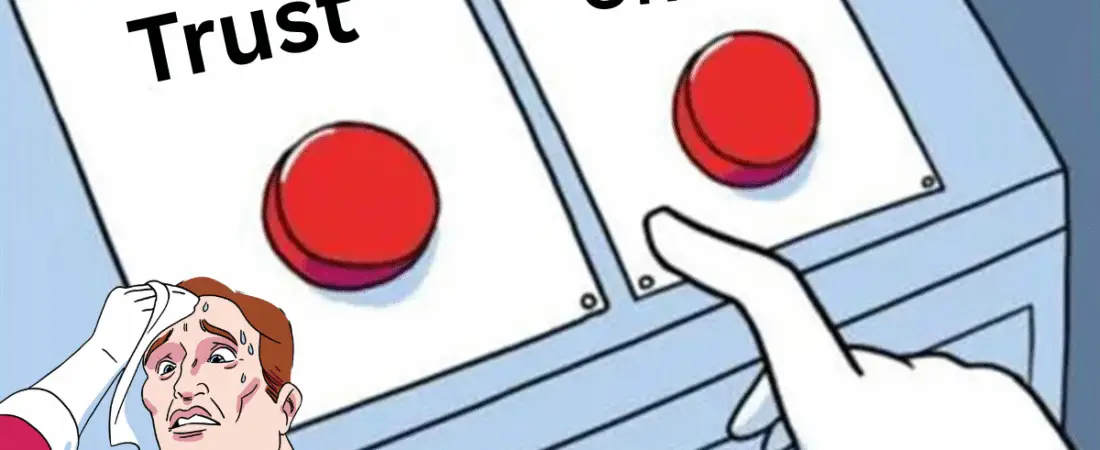
Most businesses recognize that trust starts when someone visits their website.
This is usually where optimization starts – testing headlines, refining copy, measuring conversion rates. But in reality, when a campaign performs poorly, the problem rarely sits on the landing page. This happens before, most analytics dashboards never appear in such an area.
A decision about trust is being made before the click is even made.
Working with many brands and campaigns across different industries, I’ve seen it time and time again: ads with solid offers, clear messaging, and clean design still struggle. Not because the value proposition is wrong, but because the audience never fully trusted the source. By the time clicking becomes an option, hesitation has set in.
What appears to be a “low click-through rate” is often a trust problem disguised as a performance problem.
Where the decision actually takes place
Business audiences do not evaluate companies the way marketers imagine.
They rarely stop to analyze the benefits rationally. They rarely systematically compare your offer to others. Most of the time, executives, managers, and decision-makers are busy, distracted, or rapidly scanning between priorities. At that stage, the brain doesn’t ask, “Is this a good offer?”
It asks, “Do I feel safe associating with this company?”
The answer to that question is found within a few seconds.
The visual tone, brand identity, and manner of delivering the message – all are processed subconsciously. When something feels incongruous, unfamiliar, or overly curious, the instinctive reaction is to move on. No conscious rejection, just silent avoidance.
This is why even sophisticated campaigns often fail without visible warning. Potential customers don’t complain; They simply don’t engage.
Why does introduction matter more than persuasion?
The clearest pattern I’ve seen in commercial campaigns is this: companies that appear consistently across different channels and contexts require less explaining.
Even when their messaging isn’t perfect, they still outperform brands that suddenly come out with offers. Familiarity creates psychological safety, reducing the perceived risk of engagement, even if the audience does not consciously remember every interaction.
It’s not about exposure for exposure’s sake. It’s about consistency over time – consistent messaging, tone and positioning. When those elements are repeated reliably, trust is quietly built.
Brands that constantly change voice, visuals or approach may appear creative, but feel unstable to decision makers. In a business context, instability is the enemy of trust.
The role of tone (and why over-polish can have adverse effects)
Another common pitfall for businesses is trying too hard to impress potential customers or partners.
Excessively sophisticated language, exaggerated confidence, or aggressive certainty often arouse suspicion. It doesn’t convey authority – it conveys rehearsed marketing. Business audiences today are highly sensitive to “marketing tone”, especially when evaluating potential vendors, partners or service providers.
A calm, explanatory tone works much better. One that demonstrates understanding and expertise without being over-selling. When content explains rather than promises, readers relax. When it observes rather than announces, decision makers listen.
Trust isn’t built by looking smart – it’s built by seeming down-to-earth and trustworthy.
Why does social proof work best when it’s subtle?
Businesses love social proof, but it is often misused.
Obvious demonstrations of “look how many customers we have” or “our product is #1” can lead to pushback. The most effective social proof is calm and naturally integrated:
– Thoughtful comments or engagement from respected industry players
– References from other trusted companies
– Mentions in discussions that feel organic rather than staged
When social proof seems contingent, trust grows without effort. The harder you try to prove credibility, the less credible it becomes.
What does this mean in practice for businesses
If trust isn’t established before the click, everything next becomes more difficult.
The campaign seems expensive. Content has been ignored. The funnels appear fragile. Companies keep optimizing endlessly for a problem that isn’t technical – it’s psychological.
When trust is established early, the opposite happens. Engagement improves. Decision makers approach content with curiosity rather than skepticism. Even mistakes or missteps are more easily forgiven, because credibility has already been earned.
This isn’t something a new title can fix. Trust is earned over time through consistency, clarity, and restraint.
The real change companies need to make
This change isn’t tactical – it’s strategic.
Instead of asking, “How do I get clicks?”
The better question is: “How do I convince potential customers to connect with my business?”
Answer honestly, and everything changes: the message, the tone, the positioning, even the campaign’s priorities. Gradually, without any tricks or shortcuts, trust begins to be built – exactly where it matters most.
Before clicking.
Final thoughts
The first click is not the beginning of the customer journey.
This is the result of already established trust.
If your campaigns struggle despite careful planning and investment, look earlier in the journey. Trust can be lost long before your visitors even reach your site.
No amount of optimization or advertising expenditure can replace that foundation.